Engineering prototypes, 3D printed in Brisbane
We 3D print functional prototypes from your STEP or STL to a typical tolerance of ±0.2 mm, so you can test fit, form and function before you commit to tooling or a supplier run.
- STEP, STL, 3MF
- PETG to carbon-fibre nylon
- NDA on request
- typical tolerance
- ±0.2 mm
- standard layer height
- 0.2 mm
- mm single piece, in any material
- 350 × 320 × 325
- identical parts get a batch discount
- 10+
What it is
Functional prototype parts printed from your CAD. One part or a short series, in the material closest to your production intent. A mechanical engineer on the team reviews tolerances, fits and material choice when the job needs it.
No CAD yet? Our CAD design and 3D modelling service builds the model from a sketch, drawing, photos or the part itself, then we print it.
Who it's for
Teams that need a real part in hand before they spend on tooling.
Product designers
Validating fit before injection moulding.
Engineers
Testing assemblies, jigs and fixtures.
Fabricators and workshops
A one-off bracket, housing or adaptor.
R&D teams
Iterating quickly between versions.
How it works
Four steps from file to part, and the same four for every revision.
Send your file
STEP (preferred), STL or 3MF, with critical dimensions or fits noted.
Check and quote
We check printability and orientation, confirm material and infill, flag anything that won't print as drawn, and quote.
Print and check
Print, check against your critical dimensions, and send or hold for pickup.
Iterate
Revised files are re-quoted from the same job.
Materials and limits
- PLA and PLA+ for form checks; PETG, ABS, ASA for functional parts
- Polycarbonate, carbon-fibre and glass-fibre blends and nylon carbon-fibre (PA6-CF, PAHT-CF) for stiffness, heat or wear, printed on our Bambu Lab H2C and H2D; see engineering materials. These need drying and conditioning, and some filaments are ordered in, so they take longer.
- Infill: 15 % standard for general parts; 25, 50 or 100 % (solid) for load-bearing parts
- 0.2 mm layers standard; finer on request
- Typical tolerance: ±0.2 mm on the Bambu Lab machines; ±0.5 mm or ±0.5 % of the dimension (whichever is greater) on the large-format machine, which runs a 0.8 mm nozzle. State critical fits and we compensate in the file.
- Single pieces up to about 350 × 320 × 325 mm in any material. Bigger parts are split into sections with designed connectors, or printed in one piece up to 800 × 800 × 1000 mm on the large-format printer in PLA, PLA+ or PETG.
★★★★★
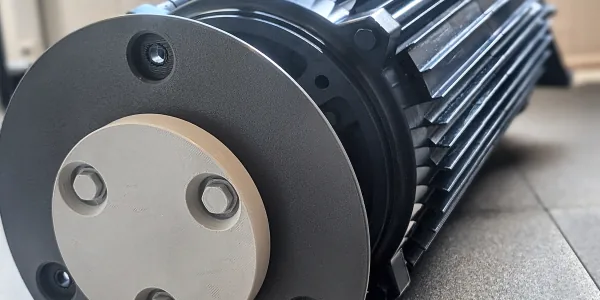
"Great experience dealing with Brisbane 3D Printing; they are extremely responsive with a quick turnaround time. I needed a dual-T mount adapter and they produced the print that both works perfectly, and holds up strength-wise with the material that they advised."
Working with businesses
We sign NDAs for business clients after review, discount runs of 10 or more identical parts, and support ongoing prototyping, with each revision re-quoted from the same job. The batch discount grows with the total print time of the run.
Every prototype is quoted on print time and material weight, with a $50 minimum including GST. Polycarbonate carries a $15 setup fee per job and carbon-fibre or glass-fibre blends $90, for the extra drying and handling. Typical figures are on our 3D printing prices page.
What you receive
- Printed part(s), checked against the dimensions you flagged
- Notes on anything we changed to make it printable
- Your revised file if we edited it
Engineering prototype questions
Which material should I use for a functional prototype?
Start with PETG: it is stronger than PLA, moisture-resistant and takes a knock. Parts that live outdoors or near heat go to ASA or ABS. When stiffness, temperature or wear matter, polycarbonate, carbon-fibre blends or nylon carbon-fibre (PA6-CF) are the step up; see engineering materials.
What infill should my part have?
15 % infill is our standard for display and general parts, and keeps print time down. Load-bearing brackets, fixtures and parts assembled to others go to 25, 50 or 100 % (solid). Infill changes both strength and print time, so it is one of the first things we ask about.
How accurate are 3D printed prototypes?
Typically ±0.2 mm on our Bambu Lab printers, with a 0.4 mm nozzle and 0.2 mm layers. Tell us which dimensions are critical and we plan orientation and settings around them, or compensate in the file. If a part needs a tighter process than FDM, we say so.
How much does a 3D printed prototype cost?
Every prototype is quoted on print time and material weight, with a $50 minimum including GST. Engineering materials add a one-off setup fee per job. Our prices page lists typical figures and every setup fee.
Can you work from a drawing or sketch?
Yes. Our CAD design and 3D modelling service builds the model at $80 per hour, then the print is quoted once the model is final.
Do you discount production runs?
Yes. Runs of 10 or more identical parts are discounted, and the discount grows with the total print time of the run.
Do you sign NDAs?
Yes, for business clients, after we've reviewed it. Send it with the enquiry.
Send us your file
Upload your STL, STEP or 3MF and we'll come back with a fixed price.
Send your files